The Diamond Colombia Wants to Shape
By Luz Mary Escobar Moreno, Field Correspondent.
Where the First Pitch Is Born
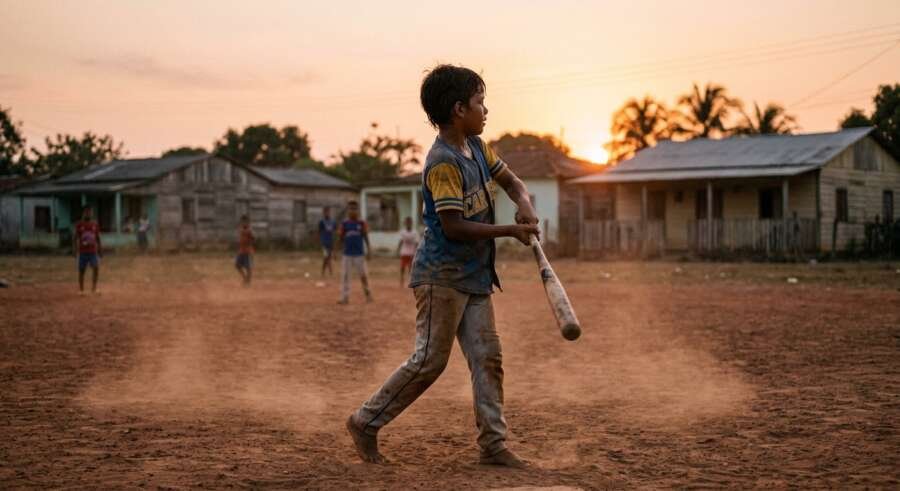
There is a certain hour in Colombia’s Caribbean region when the heat finally begins to surrender and the towns change their rhythm. The fruit vendor’s call drifts through the streets, blending with the whistle of birds settling into the trees. Motorcycles leave behind thin clouds of dust, and almost without anyone noticing, children begin to appear with worn baseball gloves hanging from their shoulders.
It happens in Sincelejo. It happens in Montería. It happens in small rural communities that barely earn a place on the map. There, no stadium is needed to know that baseball time has arrived. A patch of level ground is enough. Two stones become bases. One coach arrives before everyone else, tracing the lines of an imaginary diamond with the tip of his shoe.
In places like these, baseball has never been just a game.
It teaches children how to wait their turn, how to trust a teammate, and how to discover that perseverance can be passed from one generation to the next. Some boys arrive carrying a bat over their shoulder. Others bring nothing but hope. By the end of the afternoon, they are all sharing the same glove, the same baseball, and the same dream.
No one understands that better than the coaches.
Many of them once played amateur baseball themselves. Some reached Colombia’s national leagues. Others watched the opportunity for a professional career slip away because life demanded they start working long before their talent had fully matured. Yet every afternoon they return to the dirt field with the same discipline that others bring to an office. They earn no paycheck. What they receive instead is something quieter: the satisfaction of watching a child catch a hard line drive that would have sailed past him only a month before.
In the departments of Córdoba and Sucre, that scene has repeated itself for generations. Little League programs, neighborhood baseball schools, and community-run youth academies have kept alive a tradition that has made Colombia’s Caribbean coast one of the country’s greatest baseball cradles.
Behind every player who eventually reaches a higher level stands a long line of people whose names rarely appear anywhere: fathers organizing raffles to buy uniforms, mothers mending torn baseball pants after every practice, neighbors lending a pickup truck so a team can travel to a weekend tournament, and coaches quietly paying for baseballs out of their own pockets so that no child has to stop playing because there isn’t one left.
From the outside, it is easy to believe that baseball begins when a scout arrives at a tournament.
The truth is that it begins much earlier.
It begins when a child learns to care for a glove as though it were a family heirloom because there may never be another one. It begins when a coach patiently corrects the same swing a hundred times without ever raising his voice. It begins when an entire team celebrates the first clean hit from the teammate who had gone weeks without making contact.
Those dusty diamonds teach lessons that never appear on a stat sheet.
They teach children how to lose without giving up. How to win without humiliating an opponent. How to listen. How to wake before dawn. How to keep their word.
Many of those lessons endure long after the dream of professional baseball has faded.
That is why the true value of a grassroots baseball academy cannot be measured only by the number of players who sign professional contracts. Its greatest achievement lies in the hundreds of young lives redirected because one coach chose to stay when it would have been easier to leave.
For decades, Caribbean afternoons have continued writing the same story with different names.
The children change.
The neighborhoods change.
The uniforms change—when there are uniforms at all.
What never changes is the quiet conviction that somewhere in Sincelejo or Montería, the next great Colombian ballplayer may already be chasing a weathered baseball across a dusty field, barefoot, long before anyone knows his name.
Perhaps that is why those who truly understand baseball on Colombia’s Caribbean coast rarely begin by talking about stadiums or championships.
They talk about neighborhood academies.
They talk about coaches.
They talk about parents.
They talk about those humble grassroots programs where talent still has no famous last name, yet already bears an unmistakable resemblance to the future.
Because before there is ever a professional athlete, before the contracts, the television cameras, or the applause, there is always a child waiting for someone to believe in him.
Talent Was Never the Problem
There is an image that repeats itself throughout many corners of Colombia’s Caribbean region and that, perhaps because it has become so familiar, people have begun to accept it as normal.
A coach stores baseballs inside a sack because there is no proper room where equipment can be protected. Before ending practice, he reminds the children that there will be a tournament on Saturday—if enough money can be found to rent transportation.
The parents look at one another.
Someone suggests organizing a fundraiser. Another offers to sell traditional food during the week. A mother volunteers to bring ice so the players can stay hydrated. Nobody asks who will pay.
Everyone simply looks for a way to make it happen.
That is how much of youth baseball in Colombia’s Caribbean coast has survived: through solidarity.
Not because it was the ideal formula.
Because for many years, it was the only one.
Many coaches knocked on doors. Mayors’ offices, regional governments, sports institutions, private companies, and community leaders heard proposals that rarely demanded large investments. Most requests were modest: a few pieces of equipment, maintenance for a field, transportation to attend a tournament, or basic support so that a child would not have to abandon baseball simply because his family could not afford the cost.
Promises often arrived.
Some appeared during election seasons, when sports occupied a prominent place in political speeches. Others emerged after successful tournaments, when photographs with young athletes offered a convenient symbol of commitment.
But too often, the enthusiasm disappeared where budgets began or where administrations changed.
The grassroots academies learned not to stop because of it.
They continued practicing with bats repaired again and again. They shared gloves among several players. They created makeshift training spaces with used tires and concrete blocks. They drew a new baseball diamond every afternoon on the same piece of earth because the rain had erased the lines from the day before.
The remarkable thing is that, despite everything, talented players continued to emerge.
But that reality contains a paradox that Colombia should not accept as inevitable.
For decades, the country has celebrated those who managed to make it. Perhaps it is time to also ask about those who never had the opportunity to discover how far they could go.
How many gifted pitchers stopped throwing because the cost of transportation to a tournament exceeded what their families could afford in a week?
How many talented hitters left the game after finishing school because they needed to work?
How many exceptional young players were never discovered because the academy where they trained was not even part of an official talent network?
These are questions that are impossible to answer precisely.
And that is exactly the problem.
Those children never appeared in the statistics.
For years, Colombia has measured baseball success by counting the players who reach the professional level. Perhaps the country should also begin measuring the talent that never had the chance to fully develop because opportunity never arrived.
That invisible talent represents one of the greatest losses for Colombian sports.
Not only because some of those players might have become champions, but because every child who leaves a sports academy loses something far more valuable: a place where discipline, leadership, confidence, and hope are built.
The future of Colombian baseball does not depend only on discovering the next great player.
It depends on creating a system capable of finding that player before poverty, limited resources, or lack of support forces him or her to walk away from the dream.
This is precisely the opportunity created by President-elect Abelardo de la Espriella’s proposal to launch a national census of sports schools, with special attention to Colombia’s Caribbean region, in order to identify forgotten grassroots programs, work together with local communities and private partners, and transform sports into a true industry.
Because a sports industry does not begin when an athlete signs a professional contract.
It begins much earlier.
It begins when a child walks onto a field for the first time and finds a prepared coach, a glove that fits his hand, a community that supports his family, and a country willing to believe in his talent from the very first pitch.
The First Great Asset of a Sports Industry: Talent
When President-elect Abelardo de la Espriella expressed his intention to launch a national census of sports schools, with special attention to Colombia’s Caribbean region, he introduced an idea that could change the way the country understands sports: moving beyond seeing sports only as competition and recognizing them as an industry capable of creating opportunity, employment, and regional development.
That vision begins with one essential asset:
Talent.
Before a packed stadium, before an international contract, before a television broadcast or a sports brand attached to a team, there is a child learning the first movements of the game.
There is a family supporting a dream.
There is a coach teaching discipline on a field where resources often do not match the human potential standing before him.
If Colombia wants to build a true sports industry, the first great investment must be made where everything begins: grassroots development.
The experience of the world’s leading baseball nations shows a fundamental truth:
Talent alone does not build industries.
Talent needs systems.
The most successful baseball academies around the world do far more than train players. They create comprehensive development pathways where specialized coaches, strength and conditioning professionals, sports physicians, nutritionists, psychologists, performance analysts, and technology experts work together.
Every young player identified as a potential prospect enters a development process where progress can be measured, supported, and improved.
Colombia has the opportunity to adapt that model to its own reality.
A national grassroots baseball program could become a platform capable of identifying promising players at an early age—especially in regions with deep baseball traditions such as the Caribbean coast—and providing them with tools that are already standard in the world’s most successful baseball environments.
Such a system could include a national talent database, regular physical and technical evaluations, continuous education for community coaches, equipment support, partnerships with schools and universities, medical and nutritional monitoring, and digital platforms to track each player’s development.
Technology can play a meaningful role in this process.
Video analysis systems, motion sensors, and artificial intelligence tools can help identify patterns, refine mechanics, and improve training decisions. Not to replace the human connection between coach and player, but to expand the coach’s ability to develop talent.
The coach who spent decades working with nothing more than a notebook, a baseball, and experience deserves access to the tools of the twenty-first century.
A well-structured sports industry creates value long before an athlete reaches the major leagues.
It creates jobs in player development, sporting events, tourism, audiovisual production, official merchandise, performance technology, specialized medical services, and countless entrepreneurial opportunities.
With the right structure, Colombian baseball could gradually become a business platform connected to international markets.
A strengthened domestic baseball ecosystem could generate revenue through television and digital streaming rights, regional and national sponsorships, commercial licensing, official merchandise, and partnerships with international sports organizations.
The best prospects could create pathways toward professional contracts with teams in the United States, Japan, and other markets where athletic talent represents a multibillion-dollar industry.
It is not unrealistic to imagine a baseball ecosystem capable of generating millions of dollars in economic activity in the coming years if it successfully connects three essential elements:
-Identified talent.
-Professional development.
-Private-sector participation.
The Colombian Caribbean already possesses one of the hardest assets to create:
A deeply rooted baseball culture.
It has children who want to play. Families who support them. Coaches with decades of accumulated knowledge. Communities where baseball is part of their identity.
The challenge now is transforming that scattered energy into an organized ecosystem.
That is why a national sports census could become much more than an administrative tool. It could become the first step toward discovering, organizing, and connecting thousands of stories that today remain isolated.
It could become the meeting point between government, communities, and private enterprise to build a new chapter in Colombian sports.
The greatest opportunity is not only discovering the next champion.
It is creating the conditions for thousands of children to have a real chance to try.
Because behind every great player there was a first opportunity.
A first coach.
A first team.
A first place where someone said:
This child is worth believing in.
May the team supporting President-elect Abelardo de la Espriella’s vision be prepared to transform that ambition into a solid, technical, and sustainable policy capable of overcoming the barriers that have limited the growth of so many grassroots programs for decades.
If Colombia succeeds in building that first link in the chain, sports industry will no longer be a promise.
It will become a reality.
Sports investors who are ready to invest should take notice.
