
From the Neighborhood to the Major Leagues: A Dream Colombia Must Nurture
By Luz Mary Escobar Moreno, Field Correspondent.
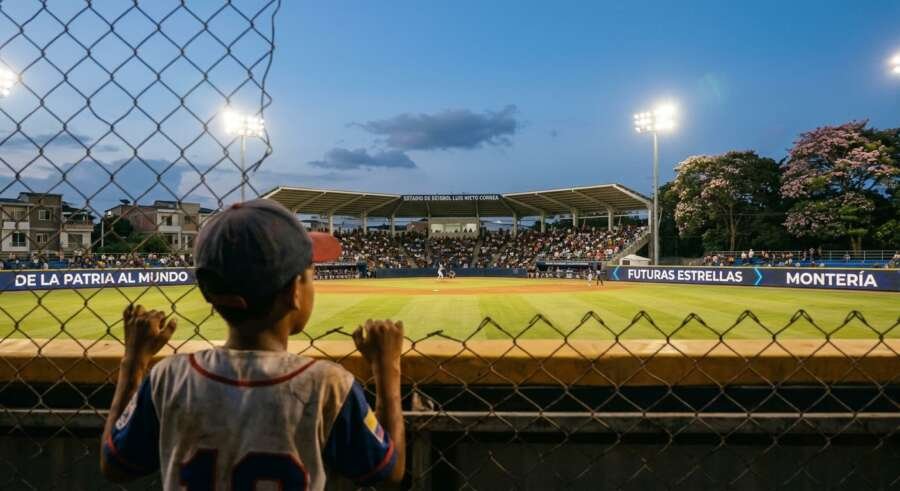
Montería, the capital of Córdoba Department in Colombia’s Caribbean region, has just unveiled a sports venue that opens up new opportunities for the next generation of baseball players. Inaugurated on October 3, 2026, the Luis Nieto Baseball and Softball Stadium represents an investment in young talent and in a sporting tradition deeply rooted in the identity of this region.
Located in the La Pradera neighborhood, the stadium bears the name of Luis Eduardo Nieto Correa, known as Professor Lucho Nieto, a coach who devoted more than twenty years to developing young baseball players. His legacy lives on at a venue where generations of children have learned the fundamentals of the game under the guidance of coaches who keep the passion for the diamond alive. The renovation honors that history and provides better conditions for it to continue.
Covering more than 10,000 square meters and representing an investment of over 8.6 billion Colombian pesos, the complex features a first-class playing field, covered stands, a batting cage, an outdoor gym, calisthenics areas, walking paths, open plazas, and green spaces. By combining sports facilities with community spaces, the venue becomes much more than a place to play: it is an environment designed for training, bringing people together, and developing the physical and personal skills that sports demand.
The canopied grandstands offer greater comfort for spectators attending games. The batting cage provides a dedicated space for refining technique, while the complementary facilities expand opportunities for physical conditioning. For clubs, coaches, and families, these improvements create better conditions for supporting the development of young players.
The inauguration was attended by Colombian President Abelardo de la Espriella, Córdoba Governor Erasmo Zuleta Bechara, and prominent baseball players from Córdoba, including Jordan Díaz and Gustavo Campero. The ceremonial first pitch symbolized a meeting between those who have already reached Major League Baseball and those just beginning to pursue that dream.
Above all, the importance of the Luis Nieto lies in its role as a place of learning and development. In a region where baseball is passed down from one generation to the next, upgraded facilities can help bring more children into the game, sharpen their skills, and give them opportunities to compete. The stadium offers local talent a place to grow with better resources, while allowing coaches and clubs to continue their work of developing the next generation.
The diamond is ready. Now comes the task of filling it with practices, games, enthusiasm, and new dreams. Perhaps among the children training in La Pradera today is a future representative of Colombia on the international baseball stage. The renovation of the Luis Nieto cannot guarantee that destiny on its own, but it does provide a renewed setting where discipline, guidance, and talent can begin to make it possible.
Baseball on the Agenda of Colombia’s New Government
The inauguration of the Luis Nieto Correa Stadium carried a significance that extended beyond sports. The presence of Colombian President Abelardo de la Espriella in his hometown, and the attention he devoted to baseball in his inaugural address, placed the sport at the center of a broader conversation about young people, opportunity, and the future of the region.
The president attended at the invitation of Córdoba Governor Erasmo Zuleta Bechara, who led the stadium’s renovation. But there was also a personal reason for his presence: the president proudly identified himself as a native of Montería and recalled that, as a child, he would have loved to have access to facilities like those now available to the young people of La Pradera. His remarks connected that personal experience with a political conviction: sports must play an important role in shaping the next generation.
“Talent helps, but it cannot replace hard work,” the president said. Throughout his speech, he emphasized discipline, perseverance, respect for the rules, and the ability to get back up after a defeat. For a baseball audience, the message is especially familiar: developing a player requires consistent practice, patience, and opportunities to compete. The president also acknowledged baseball’s historic importance in Colombia’s Caribbean region and cited Jordan Díaz, a Montería-born player who reached Major League Baseball, as an example of what regional talent can achieve.
His speech presented a vision of sports that goes beyond developing professional athletes. According to the president, a facility like the Luis Nieto should provide children and young people with a safe place to train, spend time with their families, find good coaches, and make constructive use of their free time. His government, he said, would support sports through funding, infrastructure, coaches, sports schools, tournaments, and equipment.
These statements align with the message of opportunity and social transformation that the president has associated with his political project, known as La Patria Milagro—“The Miracle Homeland.” The inauguration thus brought that vision onto the playing field: discovering talent is not enough if institutions fail to provide the conditions needed to develop it.
The contrast with the previous government is also part of the political debate accompanying the change in administration. For those who believe the previous government pushed sports and the development of children and young people to the sidelines, the new facilities and announced commitments represent an opportunity to change course. The true scope of that change, however, must be measured by the funding actually allocated, the programs put into action, and the results achieved.
What does all this mean specifically for baseball? That is the central question for this magazine’s readers. So far, the president has expressed his support for sports in general terms and explicitly recognized baseball’s place in the identity of Colombia’s Caribbean region. Yet a national plan detailing specific measures for the game remains to be seen: funding for youth leagues, support for baseball schools and clubs, coach development, national competitions, and mechanisms to identify and guide young players with international potential.
Sports Minister Juliana Gutiérrez Zuluaga has a central role to play in turning these commitments into reality. When she took office in August 2026, she identified cooperation among the state, the private sector, and local communities; stronger opportunities for athletes; and the development of talent from childhood as priorities. These areas of work could benefit baseball, although they do not yet amount to a dedicated program for the sport.
The challenge, then, is clear. Colombia has a rich baseball tradition in its Caribbean region, ambitious young players, and facilities that can help them develop. The new government has stated its intention to support sports. Now it must turn that commitment into concrete policies so baseball receives the attention it needs and deserves.
An Opportunity to Change the Future of Colombian Sports
The Luis Nieto Correa Stadium opens a door. But for that door to remain open, Colombia needs more than renovated facilities: it needs a sports policy that reaches into neighborhoods, supports clubs, stands behind coaches, and creates real opportunities for the children and young people who dream of competing at the highest level.
In that regard, the commitment expressed by Colombian President Abelardo de la Espriella deserves to be taken seriously. His message that sports must occupy a central place in the development of the next generation speaks to a need that has been neglected for far too long: the recognition that investing in sports is not an unnecessary expense, but an investment in health, discipline, community, and the future.
After the previous administration’s misrule from 2022 to 2026, whose handling of sports has drawn strong criticism, the country needs fresh energy, clear priorities, and leadership that turns announcements into results. Children along Colombia’s Caribbean coast cannot keep waiting for opportunities to arrive by chance, nor should they have to rely solely on the sacrifices of their families and the efforts of coaches who, often with limited resources, keep the passion for baseball alive.
The de la Espriella government’s support for sports infrastructure and development could bring meaningful change if it translates into sustained funding, baseball schools, equipment, competitions, and guidance for emerging talent. Colombia’s Caribbean region has shown that it can produce players capable of making their way into professional baseball internationally. What it needs is to ensure that this talent finds opportunities from the very first steps.
The hope is that the Luis Nieto Correa Stadium will not stand as an isolated project, but become part of a policy that reaches other municipalities and other sports, allowing thousands of young people to find in athletics a path toward personal growth and achievement. The president’s commitment offers reasons for optimism; the responsibility now is to turn it into action.
From this column, we will continue to follow the current government’s sports policies. We will tell our readers whether the announced commitments become concrete opportunities or end up as just another politician’s promise. Above all, we will watch to see whether La Patria Milagro creates genuine space for Colombia’s future elite athletes—including the next great names in baseball—to develop their talent and achieve their dreams.
